Article
Diversifying the Nigerian Economy Beyond Oil and Gas: Benefi...
Ettah B. Essien; Florence Etta...
Article · Case Report
Diversifying the Nigerian Economy Beyond Oil and Gas: Benefits and Threats
by Ettah B. Essien; Florence Ettah Essien
Free Read online or download.
- Type
- Article
- Author
- Ettah B. Essien; Florence Ettah Essien
- Genre
- Case Report
- Year
- 2024
- Pages
- 22
About this article
Abstract
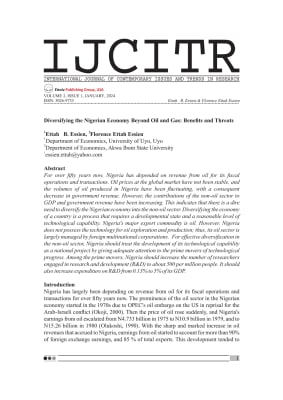
For over fifty years now, Nigeria has depended on revenue from oil for its fiscal
operations and transactions. Oil prices at the global market have not been stable, and
the volumes of oil produced in Nigeria have been fluctuating, with a consequent
decrease in government revenue. However, the contributions of the non-oil sector to
GDP and government revenue have been increasing. This indicates that there is a dire
need to diversify the Nigerian economy into the non-oil sector. Diversifying the economy
of a country is a process that requires a developmental state and a reasonable level of
technological capability. Nigeria's major export commodity is oil. However, Nigeria
does not possess the technology for oil exploration and production; thus, its oil sector is
largely managed by foreign multinational corporations. For effective diversification in
the non-oil sector, Nigeria should treat the development of its technological capability
as a national project by giving adequate attention to the prime movers of technological
progress. Among the prime movers, Nigeria should increase the number of researchers
engaged in research and development (R&D) to about 500 per million people. It should
also increase expenditure on R&D from 0.13% to 5% of its GDP.